Bouldering Grades: Comparing the V Scale, Font Scale, and Indoor Systems
Bouldering is one of the most dynamic and spectacular forms of climbing, often characterized by explosive power moves that require impeccable technique!
Understanding difficulty grades can be complicated, especially when trying to compare them to sport climbing. Internationally, two primary grading systems exist: the V Scale (Hueco), used mainly in the United States, and the Fontainebleau Scale (Font), popular in Europe. In this article, we will analyze the main bouldering grade scales, their comparison, and how to choose the right difficulty to improve your performance.
💡 Curious about how Sport Climbing grades work? Read our article here!👈
📌 The Main Bouldering Grade Scales
1. The V Scale (Hueco) – The US Standard
The V Scale, developed in the Hueco Tanks desert (Texas), is the standard in the United States and many bouldering gyms. It starts at V0 (the easiest) and theoretically has no maximum limit, with the current highest grade around V17.
✅ Examples: V0, V3, V8, V15
✅ Pros: Simple and linear
✅ Cons: Rarely used in Europe
2. The Fontainebleau Scale (Font) – The European Outdoor Standard
The Fontainebleau Scale, originating in the famous French forest near Paris, is the most used scale in Europe and Italy for outdoor bouldering. It works similarly to the French sport climbing scale, starting from 3 up to 9A+, with letters (a, b, c) and plus signs "+" to differentiate difficulty.
✅ Examples: 4+, 6A, 7C+, 8B
✅ Pros: Precise and detailed
✅ Cons: More complex compared to the V Scale
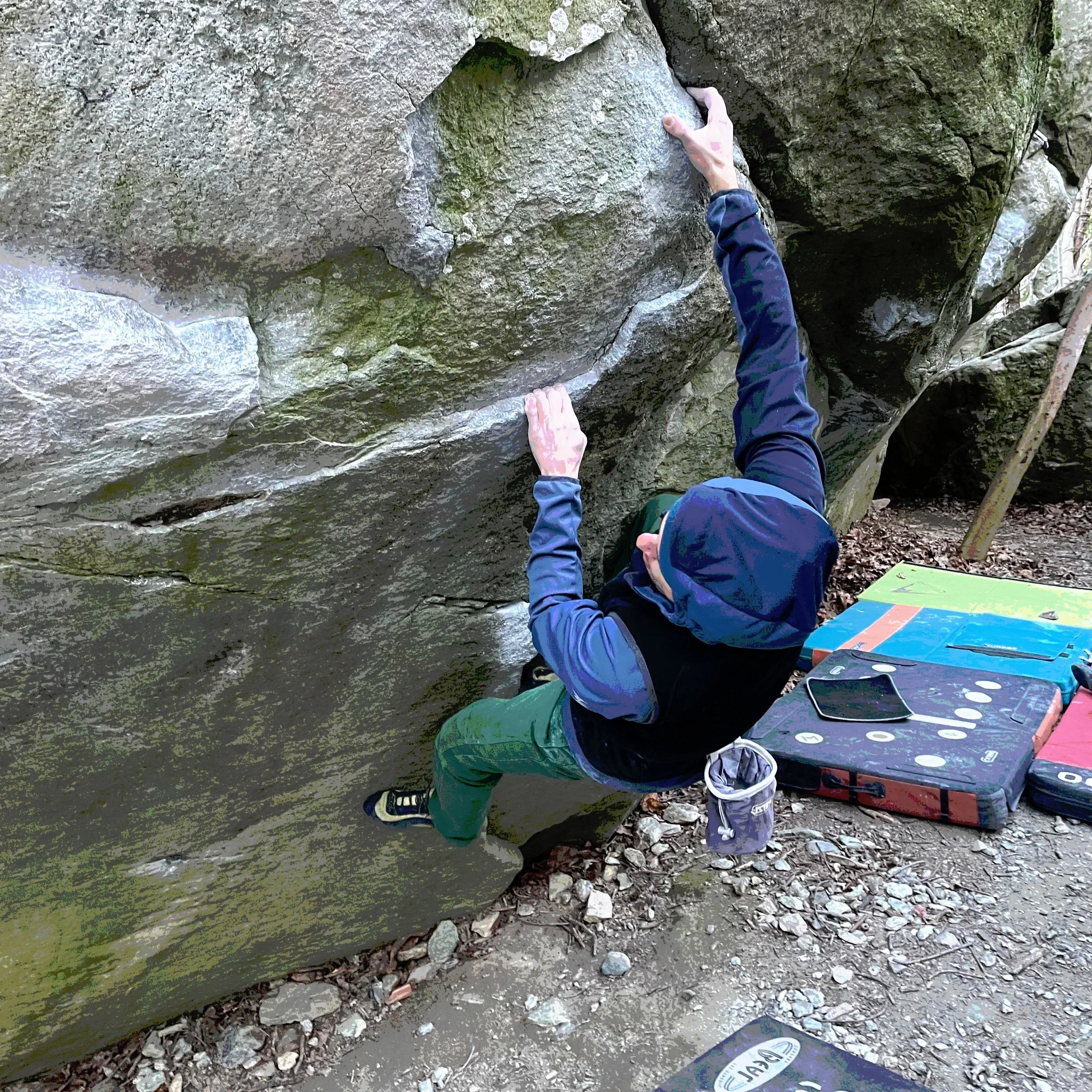
Bouldering in Varazze, where they use French grades. (Thank you Moh for modelling 😆)
3. Indoor Bouldering Grading System
3. Indoor Grading Systems (Color/Tag Based)
Most indoor bouldering gyms adopt a simplified grading system, often associated with colored tags. Some gyms use letters (e.g., from A to E), while others classify them as Easy, Medium, or Hard; in both cases, they often add a plus sign "+" for half-grades.
✅ Examples: A+, C / Medium +, Hard
✅ Pros: Highly intuitive
✅ Cons: Not precise, varies from gym to gym
🏔 Bouldering Grades Comparison Table
| Fontainebleau (Font) | V Scale (Hueco) | Difficoltà Percepita |
|---|---|---|
| 3 | VB | Molto Facile |
| 4 | V0 | Facile |
| 5 | V1 - V2 | Medio |
| 6A | V3 | Intermedio |
| 6B | V4 | Difficile |
| 6C | V5 | Molto Difficile |
| 7A | V6 - V7 | Avanzato |
| 7B | V8 | Avanzato |
| 7C | V9 | Avanzato |
| 8A | V11 | Super Sayan |
Perceived Difficulty
To help those of you who have recently started bouldering (or are yet to start!🤟), I took the liberty of adding a column called “Perceived Difficulty,” where I subjectively indicate how easy or hard a certain grade might feel, similar to the indoor gym gradings in Italy.
This conversion table offers an approximate and non-comprehensive correspondence between the different difficulty scales. Below is the link to the guide featuring all the Rockfax grades.
Rockfax Bouldering Guide
Rockfax offers one of the most comprehensive conversion charts for sport climbing and bouldering grades available. You can download free PDFs from their website using this link.
N.B. We are not affiliated with Rockfax; we just genuinely like their chart... and it’s free! 😉
🔍 How to Choose the Right Bouldering Grade?
If you are a beginner, aim for grades between 3 and 5 (Font) or V0-V2 (V Scale).
An intermediate level corresponds to 6A-6C (Font) or V3-V5 (V Scale).
If you are advanced, you will climb between 7A and 8A (Font) or V6-V11 (V Scale).
Elite athletes climb from 8A+ and up (Font Scale) or above V12 (V Scale).
🧗 Conclusion
If you are climbing in Italy or Europe, the Fontainebleau Scale is the most widely used and detailed. In the United States, you will mainly find the V Scale. In gyms, simplified systems are used instead. Understanding the conversion between these systems will help you choose the right boulders, improve your level, and face new challenges! 🚀
📢 Was this bouldering grade comparison helpful? Share it with your training partners! 💪🔥
