Climbing Grades | Scales and Difficulty Comparison
Sport climbing is practiced globally, and various difficulty grading systems exist, varying by location and the type of climbing practiced. Understanding the differences between these climbing difficulty scales is essential for those who travel or want to compare grades across different disciplines.
In this article, we will analyze the main international climbing scales, such as the French Scale, the Yosemite Decimal System (YDS), the UIAA, the British, and the Australian or Ewbank Scale.
💡 We will focus on sport climbing and trad climbing grades. The post dedicated entirely to bouldering grades can be found here!👈
📌 The Main Climbing Grade Systems
1. The French Scale (f) – The Most Used in Europe
The French Scale is widely adopted across Europe, especially for sport climbing, and is the standard in Italy, France, Spain, and much of Europe. It uses a number (from 1 to 9, theoretically without an upper limit), to which letters (a, b, c) and a plus sign "+" can be added to indicate intermediate difficulty.
✅ Examples: 5a, 6b+, 7c, 8a+
✅ Pros: Easy to understand and progressive
✅ Cons: Does not distinguish between endurance and technical difficulty
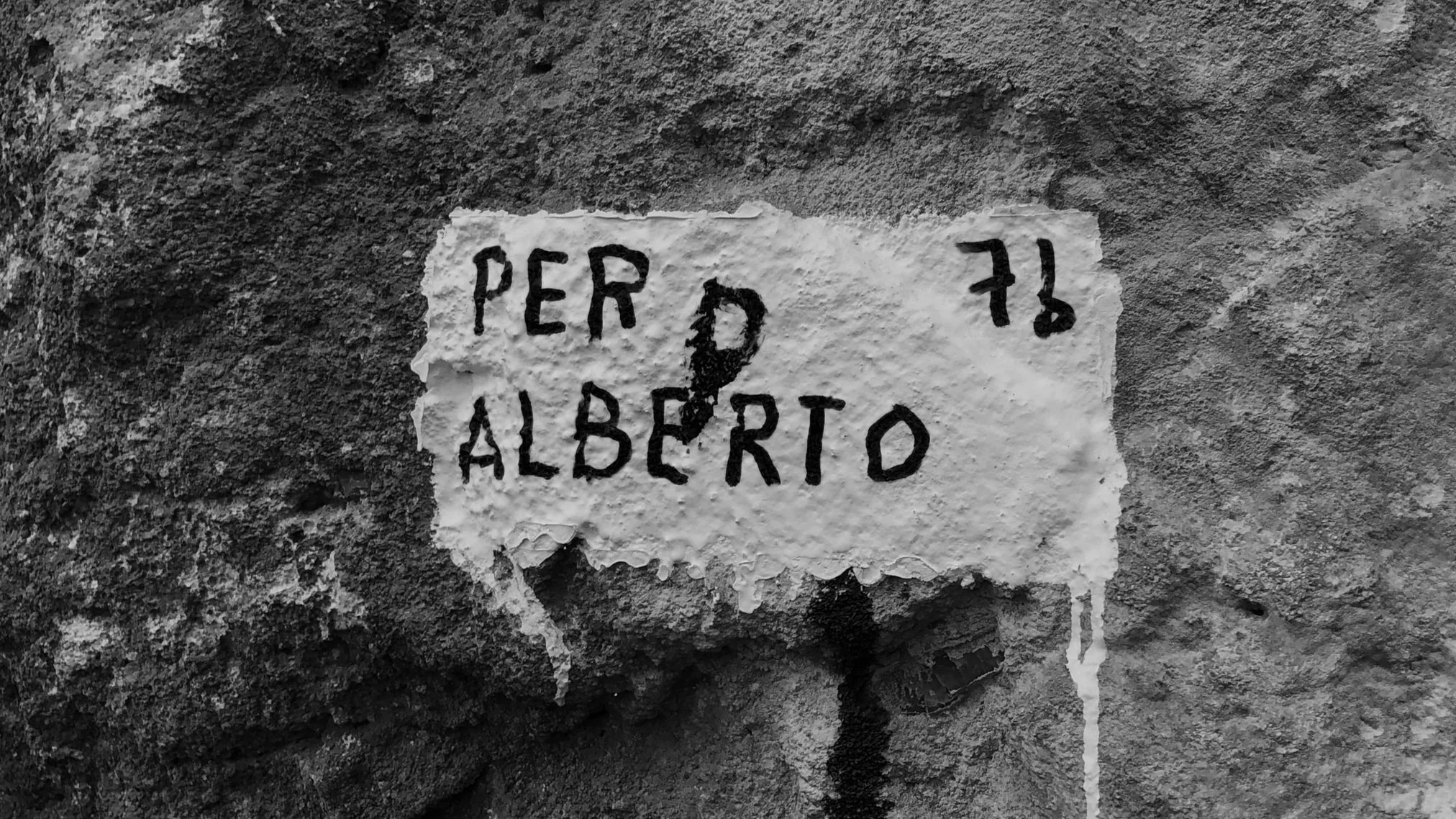
At the base of some climbing crags, in addition to the route name, the climbing grade is also displayed.
2. UIAA Scale – Used for Classic Mountaineering
The UIAA Scale (Union Internationale des Associations d'Alpinisme) is common in Germany, Austria, Switzerland, and some areas of Italy, such as the Dolomites.
It employs Roman numerals (I, II, III, etc.) with possible additions of "+" or "-" signs to indicate nuances in difficulty. Originally developed for traditional mountaineering, this scale is still used to grade classic routes.
✅ Examples: VI+, VIII-, X
✅ Pros: Used in classic mountaineering
✅ Cons: Less clear for those coming from sport climbing
3. The Yosemite Decimal System (YDS) – The US Standard
In the United States, the Yosemite Decimal System (YDS) is the standard climbing scale. It starts with the number "5." followed by a decimal (e.g., 5.10a, 5.11b) to classify rock climbing difficulties. The preceding numbers (1-4) refer to easier terrain, such as hiking or simple scrambling.
✅ Examples: 5.10a, 5.12c, 5.15b
✅ Pros: Used throughout North America
✅ Cons: Less intuitive for those accustomed to the French Scale
4. The British Scale – A Complex System for Trad Climbing
The British climbing system is unique as it combines two ratings: an adjectival grade and a technical grade. The adjectival grade describes the route's overall difficulty, taking into account factors like commitment, exposure, and the quality of protection (nuts, cams, and slings), while the technical grade evaluates the single hardest move of the route.
For example, a route might be classified as "E2 5b," where "E2" is the adjectival grade and "5b" is the technical grade.
✅ Examples: HVS 5a, E2 5c, E5 6b
✅ Pros: Accounts for risk and “protectability” of the trad route
✅ Cons: More difficult to interpret for those who are unfamiliar with it
5. The Ewbank Scale – Standard in Australia and New Zealand
The Ewbank Scale, used in Australia and New Zealand, is linear and progressive. It starts at grade 1 for the easiest climbs and increases with whole numbers as the difficulty grows, without the use of letters or additional symbols. This system is valued for its simplicity and clarity.
✅ Examples: 10 (easy), 18 (intermediate), 25 (difficult), 35+ (extreme)
✅ Pros: Simple and linear
✅ Cons: Difficult to compare directly with other climbing scales without a conversion chart
Generally, the Australian scale corresponds to the French scale with a fairly direct relationship: for example, an Australian 18 is approximately a French 5c, while a 25 is equivalent to a 7a.
🏔 Climbing Grades Comparison Table
Climbing Grades Conversion:
Given the diversity of these climbing scales, it is helpful to have a conversion table to understand the equivalences between the various grading systems.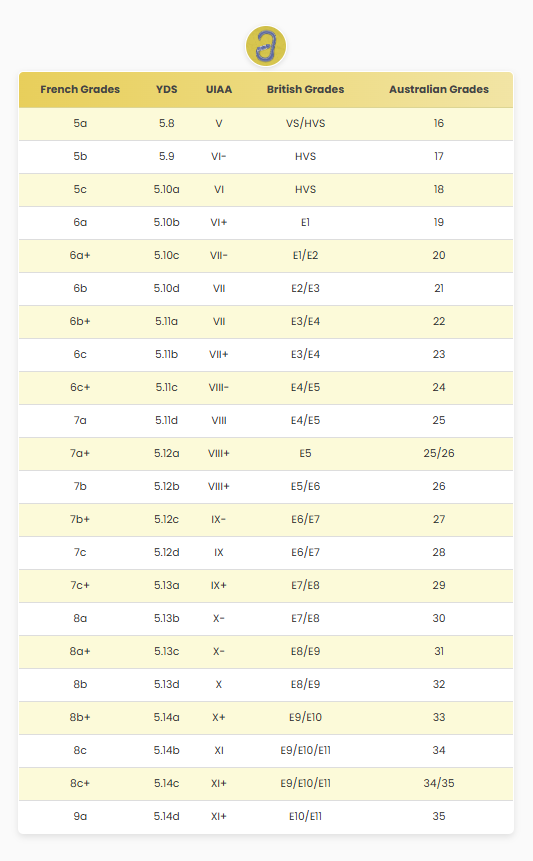
Click or tap the table to open and download the PDF version!
This conversion table offers an approximate and non-comprehensive correspondence between the different difficulty climbing scales. Below is the link to the guide featuring all the Rockfax grades.
Rockfax: A Guide for the British Scale
Rockfax offers one of the most comprehensive conversion charts for sport climbing and bouldering grades available. You can download free PDFs from their website using this link.
N.B. We are not affiliated with Rockfax; we just genuinely like their chart... and it’s free! 😉
🔍 Which Climbing Scale Should You Use?
If you are climbing in Italy or Europe, the French Scale is the main reference point. In the United States, knowing the YDS is essential. For mountaineering, UIAA is still common. If you are climbing in the UK, be ready to interpret the dual British system! For bouldering, the V Scale is the most widely used.
Understanding the climbing scale conversions will help you better choose your routes and take on new challenges around the world! 🚀
To delve deeper, you can consult resources such as Climbing Difficulty Grades - Dolomiti Guides and Difficulty Grade - Wikipedia.
